Thursday, 25 September 2014

A Confession, I'm......


Let the Bees be…

A confession, I’m superstitious.
‘Do lizards speak?’
In Bengal they do. I have quite a few lizards in my apartment in Delhi but I’ve never heard them say, ‘tik tik tik…’ The lizards, or house geckos to be more precise, here are mute. In Bengal whenever someone is narrating a tale the lizard, mostly invisible, is very likely to punctuate the story with a ‘tik…tik…tik…’.
The storyteller then is likely to light up and say, ‘You see, I told you … “thik…thik…thik…” I’m telling you the truth.’
In Bengal it’s not uncommon for house geckos to endorse your credibility. If you are saying something and the lizard buts in with a, ‘Tik…tik…tik..’ you can always claim to be telling the truth.
Are Indians, particularly Bengalis, more superstitious than others?
I cannot say for sure. I was in West Africa, where I saw some strange beliefs, some of them so macabre I cannot mention them here. So I’ll confine myself to my clansmen, the Bongs.
We Bongs have a whole long list of dos and don’ts.
We don’t eat saag, spinach or other leafy vegetables at night.
‘Why?’
‘It brings you sorrow,’ believers will tell you.
Similarly, you cannot eat Bengal’s best known vegetarian dish, sukto, at night. Why? Because it has karela or bitter gourd and eating karela at night also brings you sorrow. There are many such foods to be avoided at night. But I am not aware of foods that are to be avoided in the daytime.

Talking of foods….Banana might be a favourite with Bongs but they will never carry bananas to someone’s home. Banana, an auspicious fruit, used in pujas and other religious rituals, becomes inauspicious during travel. A Bengali will never carry bananas during travel. It’s considered, ‘a’jatra’ – loosely translated, an ill omen during travel. By the way, I can vouch for the banana being ‘a’jatra’. 

I was on a travel-reporting assignment along with a photographer from Mumbai. We had nearly finished our five day assignment and were returning to Patna for our flight back home. When we began our return journey from this remote village in Samastipur, I suddenly saw a bunch of bananas in the car. It was bought by the photographer friend. I laughingly told him about how we Bong’s considered kela to be inauspicious during travel.
Saying so, I peeled a few and ate them. Being in the field all day, we had even missed lunch. Starting our journey, soon we found our car stuck at a railway crossing. It wasn’t a red signal we realized after half an hour.  It took another hour before the broken railway crossing-gate could be put back into service and we could cross the tracks. However, when I tried to tell the photographer, ‘You remember I told you…!’ he yelled back at me, ‘Please don’t spread superstitions!’
I was shocked into silence by his unexpected, violent outburst. Here was a half-educated Mumbaikar teaching me lessons on how to conduct myself! For the rest of the journey I exchanged very few words with the man. By evening when we reached Patna, our jolly, young car driver, was on the phone. Moments later he was sobbing. His wife had been expecting a baby anytime soon. He was sobbing because she had suffered a miscarriage. We immediately made arrangements for him to get back to his wife. That’s when the photographer said, ‘Maybe you were right about the bananas.’ Chastised once, I did not respond to him.
It’s not just bananas that are considered inauspicious during travel. Bongs don’t carry - or even look at eggs - when undertaking travel. Even carrying pickles is considered ‘a’jatra’. If my granny, who passed away several decades ago, was alive she could add a lot more items to this inauspicious list.

For all inauspicious symbols there are auspicious ones too. Before starting out of the house for an examination or an interview my mom never forgot to feed me a spoon of dahi. It was said to help you. Most South Indians will never forget their ash mark on the forehead before leaving home.
Across most cultures, if seeing one common myna (Bongs call them shalik) is inauspicious seeing a pair is considered lucky. Spotting a white barn owl – Lokhir pencha, the ride of Goddess laxmi – is said to bring wealth and for Bongs (Among Mallus from Kerala the screeching of an owl means the ominous call of death). Most Hindus consider a cow or bull walking into their homes a sign of good luck. Among the Chinese, who are nearly as superstitious as we Indians, the presence of a swallow’s nest in their homes signifies a harbinger of good times, just as the arrival of sarus cranes in their locality also does.
In the middle of so many confusing omens when a swarm of honeybees settled in my balcony garden one fine day, I was pleasantly surprised. It was ironical, just a few weeks before I had written a story on the vanishing bees and how it could affect our survival in the context of agriculture. Their sudden arrival, of all places in my balcony, also confused me.
‘Did it signify anything?’
Like for all my doubts, I went to Google. Like for everything it had an answer.
‘A honeycomb in your house means honey which signifies wealth and happiness,’ Google said.
I was thrilled. Both items, wealth and happiness, would be coming to my place after a long absence. 

And Googles prophesy soon started to fructify. I got my first royalty cheque of 25,000. Yes rupees, not dollars. And, yes 25,000 is considered a fortune for B grade authors who are not Chetan Bhagat or Amish Triparthi. A travel book contract, with an advance, also became a distinct possibility. Another major writing contract was nearly there. And surprise, surprise, someone was offering me a job. ‘Will you be interested?’ they asked. Life had never looked so good.
I began to visit my balcony regularly to keep a watch on the bees, hoping they would not fly away. They remained put, working copiously. But soon the job offer flew away. In a way I was happy because with so much work in hand I would hardly be able to do justice to it. But then, after putting in a lot of effort, I realized that the travel book too was going nowhere. I had not anticipated this at all. This was a big-ticket project where I would not only be writing the travelogue but also illustrating the book. But anyway I still had hopes of the report writing project in Africa. That would give take care of bills for a year. But soon the frequency of emails from my contact in Sudan became scarce. Then one final mail drove the nail in my coffin.
‘There’s been a budget cut,’ the lady informed me, ‘let’s talk next year.’

So here am, left high and dry by my bees. Yes, once in a while I do poke a stick into the comb and lick the sweet honey. But life is nowhere sweet as Google had promised. The hope that they might still bring me good luck has restrained me from chasing away the bees. But my patience is wearing thin. One fine day I might just smoke them out.
But then, as I write, my palm has been itching. It is said to be a good sign.
‘Money will come,’ it implies.
Yesterday the milk in the kitchen also boiled over. Instead of crying over the spilled milk, I smiled. Boiling over of milk is also another good sign of lokhi (laxmi) or wealth.
Maybe, after all, I’ll let the bees be!
      

Friday, 29 August 2014

From a journey long ago....

http://www.tehelka.com/the-man-i-hated-for-his-decrepit-appearance-became-my-friend/

‘The man I hated for his decrepit appearance became my friend’

Ashim Choudhury, 56, is the author of The Sergeant’s Son. He is based in New Delhi
Illustration: Mayanglambam Dinesh
My boss once rebuked me, “Ashim, it’s not enough to work! You have to appear to be working.” It had nothing to do with unmet deadlines or the quality of my work. She was complaining about my laidback attitude. It gave the impression I was not working hard enough. It was amusing, putting up an appearance even at the workplace.
We have all been guilty sometimes of judging people by their appearance. I was no exception until I met Bhairon in the cold, remote surrounding of Shruting Valley in Kinnaur. Whipped by icy winds, surrounded by snowcapped mountains and cut across by a shimmering river, the only human habitation here was a small ITBP outpost where four of us had halted for the night after a 21-km trek from Thangi.
While my friends planned to go further to Charang, and then to Chitkul through the treacherous Charang La pass, I had decided to return, realising I could not undertake the arduous journey.
How would I find a porter for my solitary return in that desolate land? Fortunately, someone discovered a porter who had taken refuge at the ITBP barrack the night before. Lachhi, our porter, said, “Saab, this fellow will take you with him tomorrow.” I was horrified with what I saw. The nondescript fellow looked like a bundle of rags. Thin and bony, his hair unkempt, he had a dazed and unclean look about him. “I would rather stay put in Shruting than go with this fellow,” I thought.
I checked with my friends if they would exchange Lachhi for this guy. They refused. More than the fellow’s bedraggled appearance, what bothered me was that he seemed absent-minded. So next morning, when my friends waved goodbye going uphill, I retraced my steps towards Thangi pretending I had no company. For a good half an hour, I didn’t even speak to the porter following me, my bag on his thin shoulders. But soon after my initial burst of energy, I slowed down and fell behind. Every now and then, Bhairon had to wait for me to catch up.
He would follow me during steep climbs so that if I tumbled, he could stop me from falling. Then he would wait for me to get my breath back. During treacherous descents, he preceded me, just in case I lost my balance and hurtled down. When the cowherds or sheep came from the opposite direction, he tucked me into the rocks so I did not fall off the narrow path. “Babu ji, you must be careful when crossing a gorge. That’s where the rocks mostly hurtle down,” he warned. By the time we reached Lumbar, midway, the man I hated for his decrepit appearance, had indeed become a friend, philosopher and guide.
Bhairon was a worldly sort, who had once worked in Delhi as a Blueline bus driver. He planned to visit his family in Nepal, who he hadn’t met in more than a year, as soon as he had made enough money. Three kilometres short of Thangi, we stopped by the only tea shop above which Bhairon lived in a shared plastic tent. He would not let me pay for the tea, saying it was his privilege.
Then we came across a particularly treacherous stretch where the narrow ledge on which we were walking had literally disappeared. I froze. One missed step and I would hurtle into the gorge a kilometre below. But Bhairon was there for me. I held his hand to cross that risky stretch. I felt as though I was born again. If it was not for that “bundle of rags”, I wouldn’t be alive.
He found me a hotel and I was sad when he waved a final goodbye. “Never again will I judge a man by his looks,” I thought. To Bhairon, I owe my life. And to hell with putting up appearances at the workplace!
(Published in Tehelka Magazine, Volume 11 Issue 36, Dated 6 September 2014)

Monday, 4 August 2014

On the feni trail in Goa...


Feni’s tipsy-turvy fortunes

The number of feni lovers is fast shrinking in Goa. But aficionados continue to swear by the poor man’s drink, writes Ashim Choudhury

Remember the good old times when you were going to Goa for a holiday and would be burdened by pleas, “Can you bring some feni for me please?” Now, a trip to Goa no longer elicits that kind of response. Now, if you tell a friend, “I’m going to Goa… Should I bring some feni for you?” the answer very likely will be, “Nahi yaar… rehne de.” What they don’t tell you openly is that they can’t stand the whiff of feni. Meanwhile, feni has acquired a unique status after it was given GI or Geographical Indicator in 2009. GI makes Feni unique to Goa much on the lines of Tequila of Mexico, Scotch from Scotland or Champagne of France. Yet cashew feni still remains the poor man’s drink despite desperate promotional efforts by Goa’s fashionable set to keep the shrinking flock of feni drinkers.
Feni production after GI has not climbed. It is made from ripe cashew apples, fallen on the ground, but cashew apples are rotting at the farms in Goa and its surroundings, without any takers. When asked why he did not sell his cashew apples dumped on the ground, a cashew farmer on the border with Karnataka remarked, “Who will buy?”
So why has feni lost its fizz? The fact is that in the past four decades, feni production has been steadily falling, from 1,089,000 litres in 1971 to 875,000 litres in 2004. In the same period, production of distilled spirits climbed from 202,000 litres to 18.99 million litres.
One of the reasons for Goa’s current low turnover is that feni continues to be labelled ‘country liquor’, preventing its sale outside the state. Moreover, feni production still largely remains a cottage industry. Not uncommonly, it is also distilled in individual homes sans a licence. Why, even Goan priests, particularly from the south still like to brew their own feni. “They still distill it in earthen pots the traditional lavani way,” says an old Goan who knows his feni.
A major problem with feni production is that there is no uniform method of distilling it, nor is there any quality control. Not surprisingly, much of the feni sold in Goa is spurious or adulterated. A lot of it is produced by small, unlicensed producers. No wonder then, no Goan will easily take you to a ‘fenifactory’ without permission from the owner. This writer’s wait was so long he decided to go out on his own.
From Anjuna village, we set out northwards and moved along to Mapusa, finally coming upon the Goa- Mumbai highway. That’s where we met one Chengappa who told us to go further on the highway till we cross a river, and move up further. “Once you are near the bhattis, you’ll know by the smell in the air,” he tells us.
Indeed, half an hour later, after crossing the scenic river below us, our nostrils are invaded by the strong whiff of feni. This is Dhargal, some 22 km north of Panjim. Driving on the gravel road, we are soon at the feni distillery that looks somewhat like a cowshed and smells like rotting garbage. The workers at the bhatti show us around readily. What I mistake to be a drain of sewage is actually the juice of cashew apples that are being squeezed in a basket. This juice finally finds its way through gutters into large copper pots that are being constantly heated, distilled to form urak. The Kalogis have 20 matkas or stills in all. Pulp and sludge from the Kalogi distillery also flowed out untreated into the neighbouring farm, turning it into a ditch.
We found Francis, another distiller, as we were heading for the Arambol beach region when there was a sudden clearing in the forest that revealed a blue river below. In this desolate place, except for a beached boat along the serene river, there was not a soul in sight. Out of sheer curiosity, I stepped into the palm shed from where some voices emerged and lo and behold, this was a feni factory! Francis, his hands muddy from repairing a still, showed us around. He took us through the rows of urak and feni being distilled. There were several stills here, in this place taken on rent by Francis.
This distillery is a cooperative of sorts. Six friends have got together under a licence owner, who gets a fee from them. Francis and two of his friends have two stills each. The remaining three have one each. They are small distillers who come together for the months of March and April when the cashew apple is abundantly available. The feni they produce is sold directly to Goa bars. And how much does Francis make in a season? “Nothing,” he says with a sense of resignation, “A jar (20 bottles) fetches just Rs 700-800.” Francis laments that people are not drinking feni the way they did earlier. Terekholkhari, the river on whose banks the distillery is camouflaged, also serves as a border between Maharashtra and Goa. If his distillery is on the Goa side, Francis’s home across the river is in Maharashtra.
From Khareban village, my feni trail took me to Captain Vijay Shankar, formerly of the Indian Navy, who lives in Porvorim near Panaji. Hailing from Kerala, the man has not only a Goan wife but has also adopted the state as his own. He loves his feni. Some describe him as a connoisseur. He scoffs, “I’m just a feni drinker, nothing more.” Captain Shankar goes great lengths to procure his pure stock of feni and urak. “Urak is the first line distilled from the juice of cashew or neera and has a fresh fruity flavour,” he avows. It is also smoother and has to be consumed within a month of being produced, unlike feni that can be stored away for more than a year. Urak, after two-three rounds of distillation, sometimes mixed with neera, becomes what is called feni. It is great alcohol, but for its strong whiff. According to Shankar, feni has an alcohol content of 50 to 60 percent. This is much higher than the conventional whiskey or rum. But even Shankar does not take feni regularly, because “my wife will kick me out of the house”. Drinking feni makes your sweat, and other excretions, stink like the alcohol. Feni also causes you to burp, inviting frowns from polite people.
No wonder the number of feni lovers even within Goa is shrinking. Krishna Sarmalatara, a young man in his thirties from Dhargal, wrinkles his nose. “Peene ko baas marta,” he says with disdain, “so we drink ‘English’ only.”
Captain Shankar, however, is happy that the GI tag has not really taken feni off its humble roots. “Thank God,” he says, “Else, it’ll disappear from the shelves… I can’t pay Rs 500, say, like for a shot of Tequila… I pay Rs 100 for a litre of feni. Leave it alone for the sake of the common Goan.” His fears of feni going beyond the reach of the ordinary Goan have so far proved wrong. Meanwhile, coconut feni, common to south Goa, is also suffering because the toddy tappers are no longer available. Many vouch for its better taste and less odour.
Meanwhile, moves are afoot to give cashew feni ‘heritage’ or Indian Manufactured Foreign Liquor (IMFL) status so that it can be exported. After GI certification, only liquor made from cashew apples sourced within Goa can be called ‘feni’. If marketed as a Goan holiday drink, feni has huge potential. Industry people admit that GI has not helped the cashew feni cause because of the ‘country-liquor’ tag. If classified as IMFL, then the market for feni will open up.
“The GI certificate is to protect cashew feni,” says Cashew Feni Distillers and Bottlers Association president Mac Vaz, who owns popular feni brands. He says the GI tag will prevent other states such as Maharashtra and Kerala, which also produce large quantities of cashew apples, from producing and selling ‘feni’. Vaz is hopeful of the government classifying cashew feni as ‘heritage liquor’ so that it can be exported easily.
Hansel Vaz, owner of the popular feni brand Cazulo, says, “GI has recognised the 400-year-old art of feni making. Now we need to reach out to people at the grassroots, the small distillers, and tell them the importance of sticking to best practices like using copper stills, picking up only fallen fruit, not storing feni in plastic jars, and other aspects of quality.” The association has also initiated measures to certify genuine cashew feni. There are fears that this, ultimately, might edge out the small distillers who own one or two stills, making feni an exclusive club of the big boys, leaving some 45,000 people without one of their main sources of income. With the government finally waking up to feni’s newfound GI status, feni’s fizz, it appears, cannot remain bottled for long.
Ashim Choudhury is the author of The Sergeant’s Son


slide

Thursday, 19 June 2014

My recent painting....

The Forest guest house at Koti near Chail, Himachal pradesh....Spent three wonderful days here with family. June '14

Monday, 9 June 2014

The Sergeant's Son is now available on kindle!

Go to the link below to buy the e-book...

http://www.amazon.com/Sergeants-Son-Ashim-Choudhury-ebook/dp/B00KC6WB2C/ref=sr_1_1?s=digital-text&ie=UTF8&qid=1401361127&sr=1-1&keywords=The+Sergeant%27s+Son

An old, charming review in the Financial Express...


http://www.financialexpress.com/story-print/1168963


As a Child Sees

Swetha Ramakrishnan Posted online: Saturday, Sep 14, 2013 at 0000 hrs
Book: The Sergeant’s Son Author: Ashim Choudhury
Publisher: Rupa
Price: Rs 250
Pages: 244
Kalu, the protagonist of Ashim Choudhury’s The Sergeant’s Son, is a keen observer, and as he becomes the voice of the first few chapters, you get a child’s perspective of a military camp in Kalina, Bombay. We learn that Kalu’s family has made this difficult shift to a thriving metropolis from eastern India, that he is as close to his mother as he is distant from his father and that his interests lie in art, much to the disdain of his father, who wants him to join the Air Force. Choudhury’s recreation of this little boy’s world is filled with amazement and charm.
The Sergeant’s Son revolves around this six-member family, Sergeant Samar Biswas, his wife Basanti and their four children, Kalu being the third. The narrative is peppered with endearing anecdotes, and one in particular stands out for containing the winning ingredient of the book — glimpses into a child’s mind. During their stay in Bombay, the Biswas children are introduced to their uncle from Assam and his German wife. They are excited about meeting a white lady and their feverish wonder to see her draped in a sari is palpable. When the father dismisses their excited whispers by calling her a “daughter of an ordinary worker” in Germany, you can sense their disappointment.
As the story progresses, Kalu’s familiar world disappears in his struggle. His family moves to Allahabad, which is a stark contrast to Bombay. The only constant is Kalu’s timid aspiration to become an artist. Basanti constantly tries to save him from his father’s wrath, which arises from his own thwarted ambitions. This is a familiar set-up and we yearn to see Kalu’s own perspective and understanding. Here, the narrative is lost in a web of its own making as it tries to tie up ends introduced earlier.
Much of the story is probably autobiographical, as Choudhury himself reluctantly joined the Air Force in the 1970s. It is during his training in Bangalore that the idea for the book came along. The last few chapters in The Sergeant’s Son take a tumultuous turn, leaving room for a sequel. If it can retain the sensitivity and simplicity of the original, Choudhury’s future work will be something to look forward to.

Thursday, 3 April 2014

Miss the old boy Khushwant Singh!

Remembering my guruji, Khushwant Singh

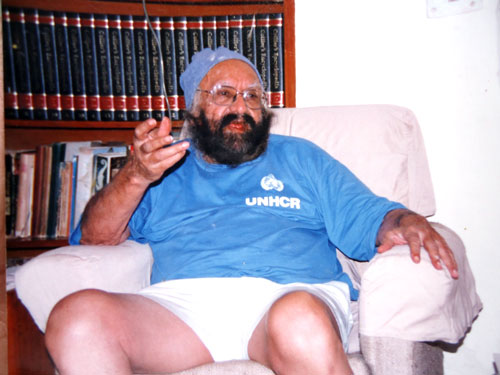
Khushwant wearing the UNHCR shirt
The grand old man of Indian writing was a friend of sorts to all people whose lives he came into. To me he was a little more. No, his hospitality never extended beyond a cola or plain water. He never shared his famous scotch with me even though on one occasion I’d bought a bottle of Black Label for him that was never delivered.
It was some 20 years back, in 1994, when I first met Khushwant Singh for my first cover story – a profile of the writer in Gentleman. His book, ‘Not a Nice man to Know’ was just out then. When I went to give him a copy of the magazine he was delighted.
‘A Nice Man to Know’, the title of my story had charmed him. And thus opened his door to me – the door on which was written the famous line, ‘Do not ring the bell if you’re not expected!’ Many a diplomat and neta had to turn back from that door for having arrived without an appointment.
To me that door was opened often with a radiant smile. Very often he was sitting on his sofa, his legs outstretched on the cane moora by the fireplace. His wife was always present in the room whenever we had met, and then she was gone. I continued to visit him, and he appeared lonely.
Once, I took along a curious friend to meet him. The friend was disappointed by the simplicity of his home. Those days there was a firing incident in a famous God man’s compound in Bangalore – or was it Hyderabad? – that was making headlines. Khushwant, curious as ever asked me if I had some inside news. Then to mine, and my friend’s shock and horror he said, “That man (god man) is a gandu…” The rest of it, told in Hindi, is unprintable. Translated, it would read, “He buggers and gets buggered as well.”
That was unadulterated Khushwant Singh. He never cloaked his words in the veneer of decency. But to even suggest that he was not a decent man would be unthinkable. The image of a debauched man frolicking with wine and women was a picture he had deliberately created to his legion of fans running into millions.
Yes, it is true he reveled in the company of women and he loved his evening tipple. Many were fooled into believing he was a debauched man. Even I had to pay a heavy price for this. I was with UNHCR then. Khushwant readily agreed to do a shoot for a film on refugees that I was making, where he spoke as a former refugee from Pakistan. Later, I had taken my boss Irene Khan, to meet him at his home. They were an instant hit. I later convinced Khushwant to do a poster for UNHCR to which, he again readily agreed.
By the time the poster was to be made Irene had left for UNHCR headquarters in Geneva and I had a new African boss. He hauled me up one fine afternoon for giving unsound advice on the poster. “Ashim your advice for featuring Khushwant Singh on a UN Refugee poster was not good,” he had said.
I was dumbfounded, but defended myself rather poorly. Later, when I asked him how he had come to such a conclusion, he produced a lady colleague. She and a few of her cronies were giggling, “Oh everyone knows about his drinking and womanizing.”
I was too disgusted for words. How I wished they were a little better read and told them so. The poster project with Khushwant was dropped. I was embarrassed. Khushwant had spent an entire afternoon doing a photo-shoot wearing a UNHCR tee shirt! My visits to him became fewer.
A few years later, out of UNHCR, I was interviewing him again for a news channel. He had just been given the ‘Honest Man of the Year’ award instituted by Sulabh International’s Bindeshwar Pathak. The citation also carried a cash prize of a million rupees. It wasn’t a small amount then.
Among many other questions I asked him what he intended doing with the money. I was expecting an exalted well thought out response, maybe of donating it to some noble cause, when pat came Khushwant’s response with a loud guffaw. “I’m going to spoil myself with that money!”
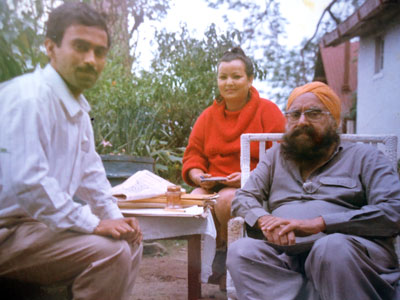
The writer with Khushwant Singh in Kasauli
Who else could give such a disarmingly candid answer like that? Khushwant Singh, above all else, was an honest man. Not surprisingly, he tore many a reputation to shreds in what used to be a delightfully malicious column. The author of over thirty books, some of them classics like ‘Train to Pakistan’, ‘I shall not hear the Nightingale’ and ‘Delhi’ did not take his own reputation very seriously. He also had the uncommon ability to laugh at himself and his community; the result, a clutch of joke books mostly on sardars. But though an agnostic he personally considered ‘The History of Sikhs’ – a scholarly work – one his best books.
Was he a helpful person? In my case, he twice recommended me to people when I was out of a job. When both attempts failed, he laughed wistfully saying that he no longer had clout. When he was a Director at Penguin he also reviewed my manuscript and gave me some useful tips, one of them, asking me to cut down on descriptions.
Alas, when ‘The Sergeant’s Son’ was out in January 2013 I could not personally hand him a copy of my debut novel. By then he was quite ill and the caretaker who took the phone said he did not meet people any more. I still took a chance one evening and the caretaker was kind enough to allow me in. Just as I was to be in his presence a young lady imperiously blocked my way. “He does not see anyone,” his granddaughter said haughtily.
Like a nervous school boy I held my book and said, I wanted to personally present him a copy. “Tell him my name, Ashim Choudhury.” She relented a bit. Looking in his direction near the fireplace, hidden from my view, she asked loudly, “Are you expecting anybody.” She repeated the question. Apparently, he nodded negatively.
“Sorry,” said the young lady, “I cannot allow you in.”
It was one of my saddest days. I was so close to my guruji and yet so far. And now, he is gone forever.
(Author of The Sergeant’s Son;blog:www.as-himch13.blogspot.in)
Ashim Choudhury